
Christmas Dinner Timings Planner
To time Christmas dinner, start from the moment you want to eat and work backwards. Take off the turkey's resting time and cooking time to find when it goes in, then fit each side into the oven or onto the hob so everything finishes together. This planner does that sum for you and shows where your oven space will not stretch.
Published by CookingCalculator.co.uk. Last reviewed .
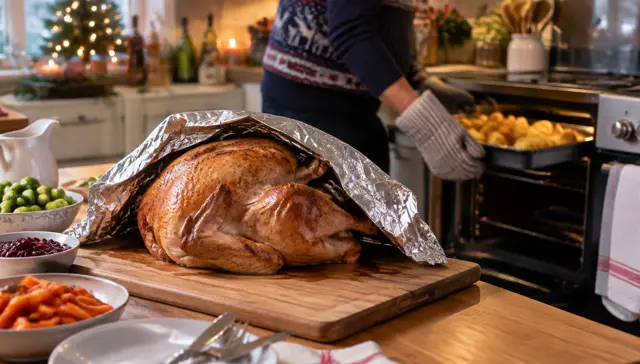
How the planner works out your Christmas dinner cooking schedule
The scheduling method below was written by CookingCalculator.co.uk. Cooking times and temperatures come from our own calculators or are labelled planning estimates, and food-safety advice comes from the Food Standards Agency.
- Every dish is set to finish at your serving time, less any resting time.
- Its cooking start is that many minutes earlier, and its preparation comes before.
- Oven dishes are placed in start order. A dish joins an oven already on if the temperature ranges you allow overlap and a shelf is free.
- Otherwise the oven needs heating or changing first, which takes the warm-up time you set (15 minutes by default).
- Hob dishes take one ring each, up to the number of rings you have.
- Anything that cannot fit is shown as a clash. The planner then tests possible fixes and only offers ones that really reduce the clashes. Nothing changes until you press Apply.
Inputs and outputs
- Serving time
- When everyone sits down to eat. Everything is worked back from this.
- Main dish and weight
- For turkey, the cooking time, temperature and rest come from our turkey cooking time calculator.
- Sides
- Each has a preparation time, cooking time, appliance and a temperature range it can share. You can edit all of them.
- Kitchen
- Number of ovens, usable shelves per oven, hob rings and oven warm-up time.
- Timetable
- A start time, a time for every step, what each oven is doing, any clashes and ways to fix them.
Assumptions
- An oven holds one temperature at a time.
- Dishes share an oven only within the temperature ranges you allow. Some ranges are our planning estimates and say so.
- Each oven dish takes one shelf unless you choose to put two on one shelf. With two ovens, a dish stays in the oven it started in.
- Each hob dish takes one ring. Parboiling potatoes counts as preparation.
- Every dish is ready at serving time. Nothing is kept hot to make the plan fit.
- Preparation is not limited by how many people are helping.
When to use your own judgement
Ovens run hot or cool, tins and starting temperatures vary, and fan ovens differ. Always check the turkey is cooked through, follow pack instructions for bought items, and adjust the figures if your own recipes take longer.
Worked example: Christmas dinner for six with one oven, served at 2pm
This example was generated by the planner itself. Inputs: a 5kg whole turkey (190 minutes at 180°C and a 45-minute rest, from our turkey calculator), roast potatoes, roast parsnips, stuffing, pigs in blankets, carrots and sprouts. Kitchen: one oven with 3 usable shelves, 4 hob rings and 15 minutes to heat or change the oven.
- First result: 4 oven clash. Roast potatoes needs 200 to 220°C, but your oven is at a temperature outside that range then, with no time to change it.
- Suggestion applied: Rest the turkey for 75 minutes and use that time for the sides.
- Suggestion applied: Make the stuffing the day before and reheat it.
- Final result: 1 clash. Cooking starts at 09:15, the turkey comes out at 12:45 and rests for 75 minutes while the oven goes up for the potatoes.
- Unresolved clash: Stuffing needs 180 to 200°C, but your oven is at a temperature outside that range then, with no time to change it. The potatoes need a steady 220°C for their full hour, and the stuffing's own figures only go up to 200°C, so one oven cannot do both at once without cutting one of them short. The planner will not quietly lower the oven or keep cooked food hot to make it fit.
One-oven alternatives the planner tested
- Make the stuffing the day before and reheat it: still 1 clash. Stuffing needs 180 to 200°C, but your oven is at a temperature outside that range then, with no time to change it. Reheating needs the same 180 to 200°C, so it meets the same problem.
- Cook the stuffing somewhere other than the oven: the rest of the meal then fits one oven with no clashes. You choose how to cook the stuffing (for example in a separate appliance) using its own instructions.
- Changing the stuffing's sharing range yourself: only do this if your recipe supports a hotter oven. The planner will not change it for you.
| Dish or task | Start | Finish | Equipment | Dependencies and notes |
|---|---|---|---|---|
| Prepare Turkey | 09:15 | 09:35 | Worktop | Must finish before the dish goes on. |
| Heat the oven to 180°C for Turkey | 09:20 | 09:35 | Oven 1, 180°C | Needed before the next oven dish. |
| Turkey into the oven at 180°C | 09:35 | 12:45 | Oven 1, 180°C | |
| Prepare Roast potatoes | 12:32 | 13:00 | Worktop | Must finish before the dish goes on. |
| Heat the oven to 220°C for Roast potatoes | 12:45 | 13:00 | Oven 1, 220°C | Needed before the next oven dish. |
| Take Turkey out, cover loosely with foil and rest | 12:45 | 14:00 | Worktop, covered | Frees the oven for the hotter sides. |
| Parboil Roast potatoes on the hob (part of the preparation) | 12:52 | 13:00 | Hob ring | Must finish before the dish goes on. |
| Roast potatoes into the oven at 220°C | 13:00 | 14:00 | Oven 1, 220°C | |
| Prepare Roast parsnips | 13:05 | 13:15 | Worktop | Must finish before the dish goes on. |
| Prepare Pigs in blankets | 13:15 | 13:25 | Worktop | Must finish before the dish goes on. |
| Roast parsnips into the oven at 220°C | 13:15 | 14:00 | Oven 1, 220°C | You chose 200°C. 220°C is inside the 190 to 220°C range you allowed, so it can share the oven. It may need a little more or less time, so check it. |
| Pigs in blankets into the oven at 220°C | 13:25 | 14:00 | Oven 1, 220°C | You chose 200°C. 220°C is inside the 190 to 220°C range you allowed, so it can share the oven. It may need a little more or less time, so check it. |
| Prepare Carrots | 13:40 | 13:50 | Worktop | Must finish before the dish goes on. |
| Stuffing: no oven free (see the clash above) | 13:40 | 14:00 | Oven, 190°C | |
| Prepare Brussels sprouts | 13:42 | 13:52 | Worktop | Must finish before the dish goes on. |
| Start Carrots on the hob | 13:50 | 14:00 | Hob ring | |
| Start Brussels sprouts on the hob | 13:52 | 14:00 | Hob ring |
Worked example: the same dinner with two ovens, served at 2pm
Same dishes and kitchen, but with a second oven. Suggestions applied: Rest the turkey for 75 minutes and use that time for the sides. Result: 0 clashes, cooking starts at 09:15, and no dish has its oven temperature changed while it is cooking.
| Dish or task | Start | Finish | Equipment | Dependencies and notes |
|---|---|---|---|---|
| Prepare Turkey | 09:15 | 09:35 | Worktop | Must finish before the dish goes on. |
| Oven 1: heat the oven to 180°C for Turkey | 09:20 | 09:35 | Oven 1, 180°C | Needed before the next oven dish. |
| Turkey into the oven at 180°C | 09:35 | 12:45 | Oven 1, 180°C | |
| Prepare Roast potatoes | 12:32 | 13:00 | Worktop | Must finish before the dish goes on. |
| Oven 1: heat the oven to 220°C for Roast potatoes | 12:45 | 13:00 | Oven 1, 220°C | Needed before the next oven dish. |
| Take Turkey out, cover loosely with foil and rest | 12:45 | 14:00 | Worktop, covered | Frees the oven for the hotter sides. |
| Parboil Roast potatoes on the hob (part of the preparation) | 12:52 | 13:00 | Hob ring | Must finish before the dish goes on. |
| Roast potatoes into the oven at 220°C | 13:00 | 14:00 | Oven 1, 220°C | |
| Prepare Roast parsnips | 13:05 | 13:15 | Worktop | Must finish before the dish goes on. |
| Oven 2: heat the oven to 190°C for Stuffing | 13:10 | 13:25 | Oven 2, 190°C | Needed before the next oven dish. |
| Prepare Pigs in blankets | 13:15 | 13:25 | Worktop | Must finish before the dish goes on. |
| Prepare Stuffing | 13:15 | 13:25 | Worktop | Must finish before the dish goes on. |
| Roast parsnips into the oven at 220°C | 13:15 | 14:00 | Oven 1, 220°C | You chose 200°C. 220°C is inside the 190 to 220°C range you allowed, so it can share the oven. It may need a little more or less time, so check it. |
| Pigs in blankets into the oven at 220°C | 13:25 | 14:00 | Oven 1, 220°C | You chose 200°C. 220°C is inside the 190 to 220°C range you allowed, so it can share the oven. It may need a little more or less time, so check it. |
| Stuffing into the oven at 190°C | 13:25 | 14:00 | Oven 2, 190°C | |
| Prepare Carrots | 13:40 | 13:50 | Worktop | Must finish before the dish goes on. |
| Prepare Brussels sprouts | 13:42 | 13:52 | Worktop | Must finish before the dish goes on. |
| Start Carrots on the hob | 13:50 | 14:00 | Hob ring | |
| Start Brussels sprouts on the hob | 13:52 | 14:00 | Hob ring |
What this example does and does not check
- Checked by the planner: each dish's cooking time, one steady oven setting per dish, oven heating time, shelf count, hob rings (including parboiling) and preparation finishing before cooking.
- Estimates: cooking times and temperatures come from our calculators or are labelled planning estimates. Sharing ranges are planning estimates.
- Needs your judgement: Some dishes cook inside the sharing range you allowed rather than at their own temperature. Their times are not adjusted, so check them. Always check food is cooked: poultry must be steaming hot all the way through with no pink meat.
What changes the timetable
- Serving at 13:00: after the same suggestions, cooking starts at 08:15 with 1 clashes. The whole plan moves with the serving time.
- Serving at 15:00: after the same suggestions, cooking starts at 10:15 with 1 clashes. The whole plan moves with the serving time.
- Shelves and hob rings: with only 2 shelves, or more hob dishes than rings, the planner reports a clash and explains it rather than keeping food hot.
- A bigger turkey means a longer cook, so the start time moves earlier by the extra cooking minutes.
Times are estimates for planning. Ovens, tins and starting temperatures vary, so check food is cooked rather than relying on the clock.
Christmas dinner timings: common questions
What time should I start cooking Christmas dinner?
Work back from serving time: subtract the turkey's rest, its cooking time, the oven warm-up and preparation. In our worked example, a 5kg turkey served at 2pm means starting preparation at about 9:15am. A smaller bird or a later meal moves that later.
Can I cook Christmas dinner with one oven?
Yes, usually. The turkey cooks first, then rests under foil while the oven goes up for the roast potatoes and other sides. Clashes happen when dishes need very different temperatures at the same time or there are not enough shelves. Sharing a shelf, moving a dish to the hob or making something the day before often solves it.
When should I cook roast potatoes while the turkey is resting?
Put them in once the turkey comes out, after the oven has been turned up to 220°C, and give them their full hour at that temperature. If another dish needs a lower oven while they roast, the planner shows it as a clash rather than quietly shortening their time. A longer rest gives more room, but keep the turkey covered and serve it within a reasonable time.
How do I time Christmas dinner for 2pm?
Enter 14:00 as the serving time with your turkey weight and sides. The planner gives the time to start, when each dish goes in, any oven temperature changes and whether everything fits your kitchen.
How do I stop Christmas dinner dishes finishing at different times?
Plan every dish to finish at the serving time, not to start at a convenient time. Then check the dishes in the oven together can share a temperature. The planner flags any dish that would need the oven at a different temperature at the same moment.
What can I prepare on Christmas Eve?
Peeling vegetables, making stuffing, and dishes such as red cabbage or bread sauce that reheat well. Cool cooked food and get it into the fridge within 1 to 2 hours, and reheat it once until steaming hot all the way through.
Related Christmas calculators
- Christmas dinner planner and checklist
- Turkey cooking time calculator by weight
- Turkey crown cooking time calculator
- Turkey size per person calculator
- Turkey defrosting time calculator
- Christmas dinner portions calculator
- Christmas dinner shopping list
- Christmas dinner cost calculator
- Roast potato cooking time calculator
- Gammon cooking time calculator
- Beef cooking time calculator
Food safety
- Poultry must be cooked all the way through. Cut into the thickest part and check it is steaming hot, the juices run clear and there is no pink meat. With a food thermometer, the middle should reach 70°C for two minutes, or an equivalent combination such as 75°C for 30 seconds.
Source: Food Standards Agency, Cooking your food: cooking poultry and pork (GOV.UK) · Reviewed 2026-09-11 · Guidance version 2.0.0
- Cooking times are a guide only. Ovens, joints and starting temperatures vary, so always check the food is cooked before serving rather than relying on the clock.
Source: Food Standards Agency, Cooking your food: cooking temperatures and times (GOV.UK) · Reviewed 2026-09-11 · Guidance version 2.0.0
- Defrost food in the fridge, not on the worktop, and make sure the middle is fully thawed with no ice crystals left. Partly defrosted food may not cook evenly. Use it within 24 hours of being fully defrosted.
Source: Food Standards Agency, How to chill, freeze and defrost food safely: defrosting food (GOV.UK) · Reviewed 2026-09-11 · Guidance version 2.0.0
- Cool cooked food at room temperature and get it into the fridge within one to two hours. Eat leftovers within two days, or freeze them. Your fridge should be between 0 and 5°C.
Source: Food Standards Agency, How to chill, freeze and defrost food safely: chilling food (GOV.UK) · Reviewed 2026-09-11 · Guidance version 2.0.0
Back to all Christmas dinner calculators.